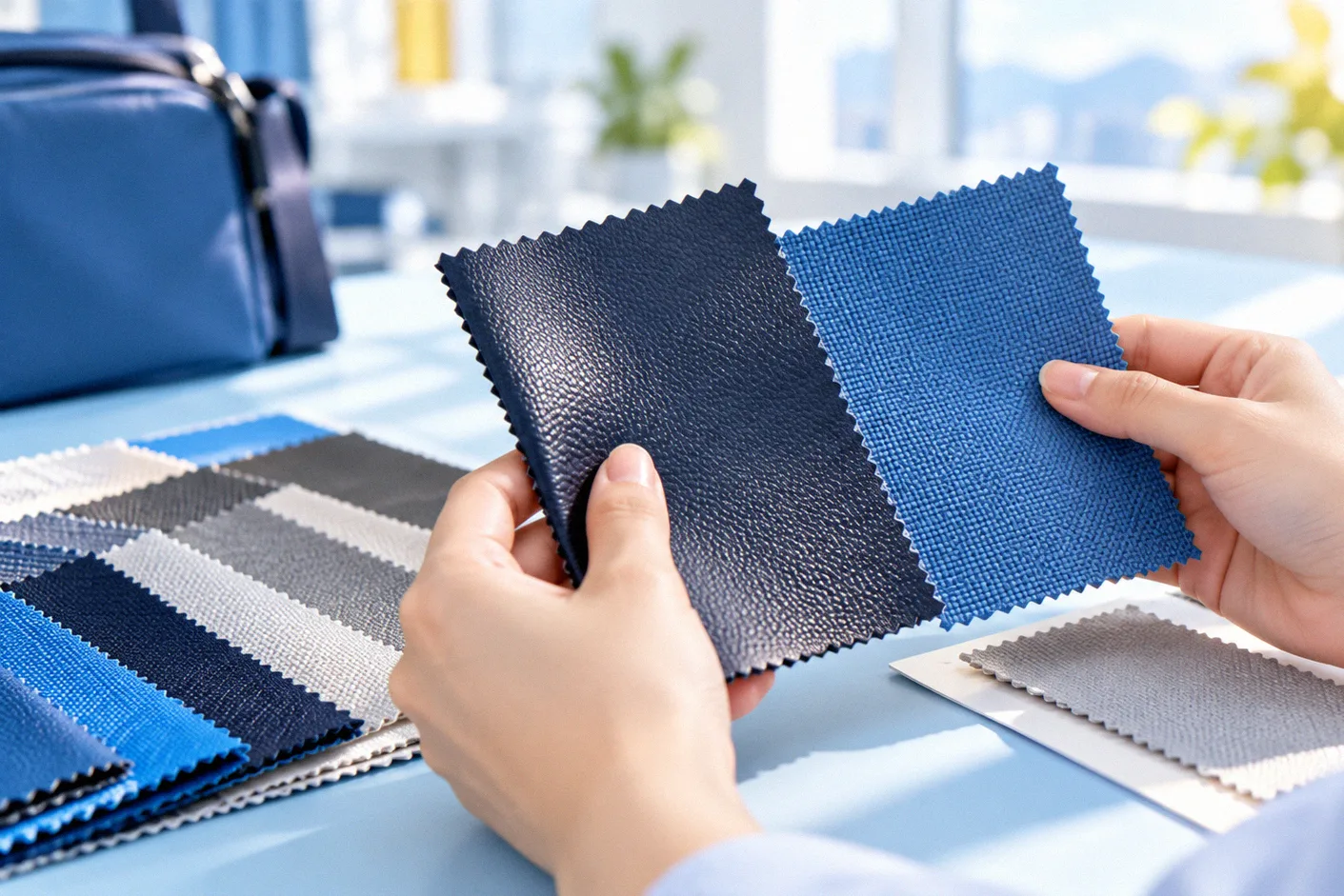
Minimum order quantity exists because a bag factory's cost is dominated by setup and line time, not by the last unit produced. Pattern preparation, material purchasing minimums, cutting die setup and production-line balancing all happen once per style regardless of whether you order 300 pieces or 3,000. Spread over a short run, those fixed costs raise the unit price; spread over a long run, they nearly disappear.
What MOQ actually covers
Three separate minimums sit behind a single MOQ number. First, material purchase: fabrics, linings and hardware are bought in roll or carton quantities, and buying a partial roll in a custom colour is either impossible or expensive. Second, setup: pattern making, marker planning and cutting setup take the same time for any run length. Third, line scheduling: a sewing line running a new style loses output during the first hours while operators learn the sequence, and a very short run may never reach full efficiency before it ends.
That is why a factory quoting MOQ from around 500 pieces per style is describing the point at which those three minimums stop distorting the price, rather than picking a number to filter out small buyers.
Why the unit price falls as quantity rises
The pattern is consistent across categories. Moving from a 500-piece test run to a few thousand pieces typically produces a meaningful drop in unit cost, driven by better material purchasing, amortised setup and a line that reaches steady-state efficiency. Beyond that, the curve flattens — the savings between 5,000 and 10,000 units are real but far smaller than the savings between 500 and 5,000, because at that point you are mostly paying for materials, labour and hardware, which scale linearly.
The practical implication is that the biggest cost improvement in a product's life usually arrives on the second order, not the fifth.
What drives unit cost besides quantity
Quantity is one lever among several. Material grade is usually the largest single factor — the gap between a mid-grade PU and genuine leather, or between 600D and 1680D polyester, moves cost more than most buyers expect. Construction complexity follows: panel count, number of compartments, piping, padded sections and specialty stitching each add line minutes. Hardware is next, especially branded zippers and custom-tooled metal fittings. Then branding method, packaging, and finally logistics.
If you need to reach a target price, work down that list in order. Reducing panel count or simplifying a pocket layout often saves more than switching to a cheaper fabric — and it does so without making the product feel cheap in hand.
How to test a market without overcommitting
A low, flexible MOQ exists precisely so brands can validate demand before scaling. Three tactics make a 500-piece test order go further:
- Test one style in two colourways rather than two styles. You reuse the pattern and setup, so the incremental cost of the second colour is far lower than the cost of a second development.
- Use stock materials and hardware for the test run. Custom-dyed fabric and custom-tooled hardware belong on the scale order, not the validation order.
- Design the test version so it can scale. If the test succeeds, you want the reorder to be the same product at a better price — not a redesign that invalidates your customer feedback.
What a factory needs to quote accurately
Accurate quotations require six inputs: bag category and approximate dimensions, outer material and lining, hardware preference, branding method, order quantity, and target unit price if you have one. Supplying the target price is not a weakness — it lets the factory propose a specification that lands there instead of quoting a version you were never going to buy.
If you want a rough figure before you send a formal inquiry, run your configuration through our bag cost calculator to get an indicative range, then use that as the starting point of the conversation.
Planning the budget realistically
Your landed cost per unit is the factory price plus sampling, plus freight, plus duties, plus any inspection fee, divided across the order. On a 500-piece test order, sampling and freight represent a larger share of landed cost than they will on any subsequent order — which is normal and worth building into the plan rather than discovering at the end. Brands that price their test run using scale-order economics are the ones that get surprised.